Overview
Health and care professionals work in some of the most demanding environments in the country. When they need specialist mental health support themselves, accessing the right care quickly can make a significant difference — not only to their wellbeing, but to their ability to remain in or return to work.
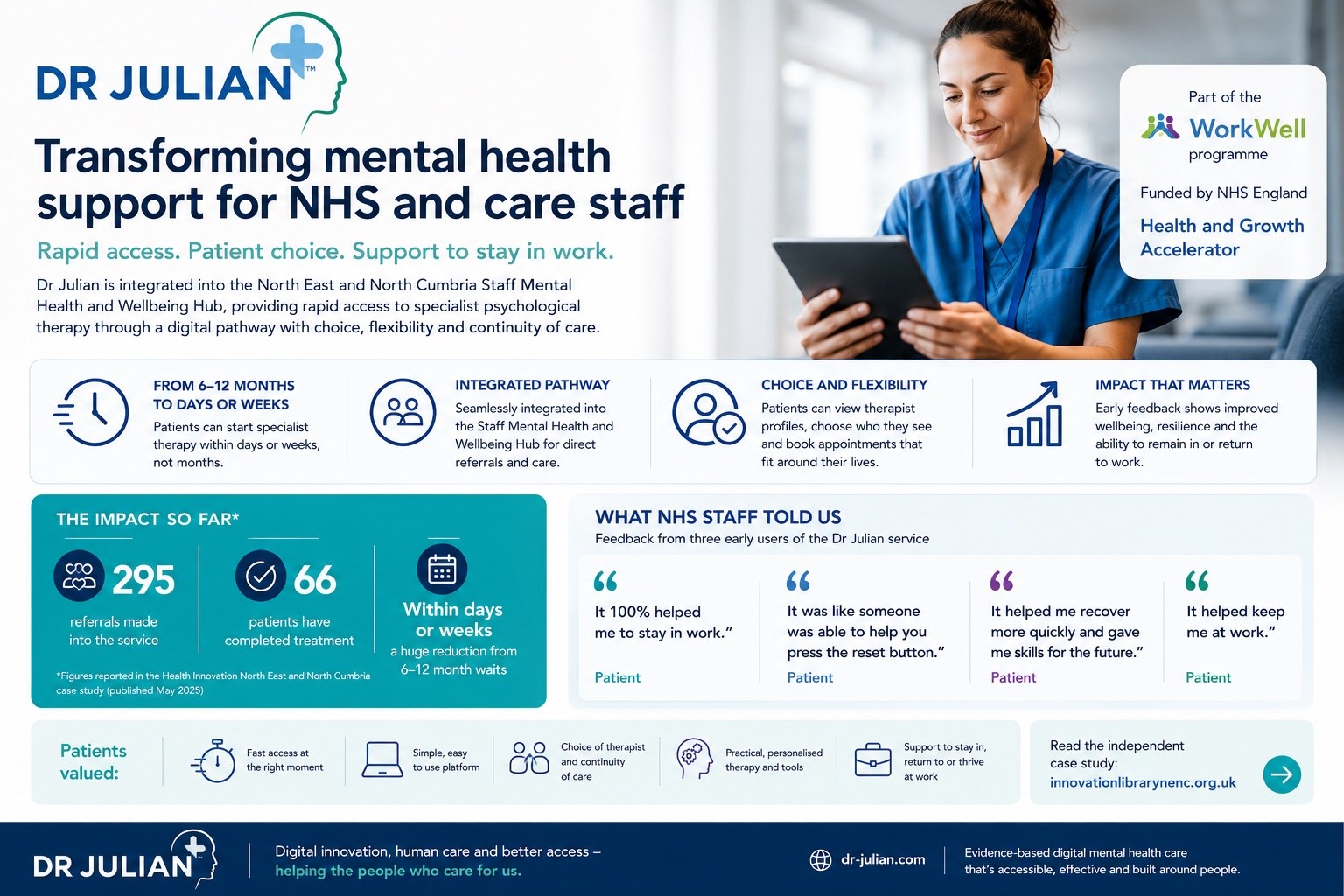
In the North East and North Cumbria, Dr Julian has been working with the Staff Mental Health and Wellbeing Hub to provide rapid access to specialist, evidence-based psychological therapy through an integrated digital pathway.
The initiative forms part of the North East and North Cumbria Integrated Care Board’s £19 million WorkWell programme and was funded through the NHS England Health and Growth Accelerator pilot programme.
The work has now been independently featured by Health Innovation North East and North Cumbria in its Innovation Library, alongside detailed feedback from NHS staff who have used the service.
The Challenge
Specialist support could mean waiting 6–12 months
The Staff Mental Health and Wellbeing Hub already provides confidential support to health and care workers across the region.
However, some people require more intensive evidence-based psychological therapy.
Historically, these staff could need to be referred back into primary care or NHS Talking Therapies pathways, where Health Innovation North East and North Cumbria reports that waiting times could reach 6–12 months.
For somebody already struggling with their mental health, that delay can matter.
Symptoms may deteriorate, sickness absence can become prolonged and opportunities to intervene earlier can be lost.
The aim was therefore not to replace the existing Hub, but to strengthen its pathway by giving its clinical team somewhere to refer people requiring more intensive support quickly and directly.
An integrated pathway to specialist therapy
Dr Julian was integrated into the Staff Mental Health and Wellbeing Hub pathway in November 2025.
People can be assessed by the Hub and supported within its existing services where appropriate. Where more intensive psychological treatment is required, clinicians can refer directly into Dr Julian.
This removes the need for patients to start again through another referral pathway.
Through Dr Julian, eligible staff can access evidence-based psychological therapies including Cognitive Behavioural Therapy, delivered by specialist clinicians through a digital platform.
Patients can view therapist profiles, choose who they would like to work with and select appointment times that fit around their lives and work.
The result is a pathway designed around both clinical need and patient choice.
Health Innovation North East and North Cumbria reports that 295 referrals had already been made into the service at the time its case study was published, with 66 patients having completed treatment.
From waits of up to a year to treatment within weeks — and sometimes days
One of the clearest impacts has been speed of access.
According to Health Innovation North East and North Cumbria, patients who could previously have faced waits of up to 12 months can now begin therapy within weeks or even days.
Dr Richard Duggin, Clinical Lead for the Staff Mental Health and Wellbeing Hub, described the impact:
“Dr Julian has been a game changer. Being able to refer a patient and see them start therapy the same day makes a huge difference — not just for the individual, but for the teams and patients they support.”
For a workforce mental health pathway, faster access is not simply about convenience.
Earlier intervention creates an opportunity to support someone before their mental health deteriorates further, potentially preventing longer periods of sickness absence and helping people remain engaged with work.
What NHS staff using Dr Julian told us
Alongside the Innovation Library case study, combined feedback was gathered from three early users of the Dr Julian service.
Although this represents early qualitative feedback from a small number of patients rather than a quantitative outcomes study, the consistency of their experiences is encouraging.
Across all three stories, patients described a positive effect on their ability to remain in work, return with greater confidence or manage workplace pressures more effectively.
Several themes emerged consistently.
Patients valued being able to begin therapy quickly and at a point when they felt ready to engage.
One patient said:
“It was really quick… that all happened within like a week or two weeks.”
Another described:
“Being able to access the service straight away when I was ready was really positive.”
Early access meant support could begin before difficulties escalated further.
Digital healthcare only improves access if patients can actually use it.
Feedback on the Dr Julian platform was consistently positive.
Patients described it as:
“Really easy to navigate.”
“Straightforward and quite self-explanatory.”
“Very, very simple.”
Appointment confirmations, reminders and pre-session questionnaires also helped patients prepare for and engage with their treatment.
Choice emerged as an important part of the patient experience.
Patients valued being able to view information about therapists before making a decision, choose appointment times that worked for them and continue seeing the same clinician.
One patient explained:
“You could have a read about them first and then make a decision on who you see.”
Another said:
“To have the choice of times and counsellors was great.”
Continuity helped patients build trust and avoided repeatedly having to retell their story.
Practical therapy that extends beyond the appointment
Patients also described therapy as active, personalised and practical.
Rather than simply having somewhere to talk, they valued techniques, visual tools, summaries, constructive challenge and coping strategies they could use outside sessions.
One patient described their therapist’s approach:
“He did the sessions in a way that just worked… very visual… it wasn’t just talking.”
Another said:
“It gave me the tools to cope with triggers… otherwise I could have ended up being off again.”
A third described learning different ways of thinking and being surprised by how much they helped.
This reflects an important principle behind our approach at Dr Julian: appointments are moments, but care should be continuous.
The aim is for patients to leave treatment not only feeling better, but equipped with practical skills they can continue to use in their everyday lives.
The outcome that matters: helping people stay in work
Perhaps the strongest theme in the patient feedback was the relationship between mental health support and work.
All three patient stories described an impact on work retention, confidence or workplace resilience.
Their words tell that story most clearly:
“It helped keep me at work.”
“It 100% helped me to stay in work.”
“It helped me recover more quickly and gave me skills for the future.”
Another patient described the overall experience simply:
“It was like someone was able to help you press the reset button.”
For NHS and care organisations facing significant workforce pressures, this relationship between timely mental healthcare, recovery and employment is particularly important.
Supporting someone’s mental health is first and foremost about the individual. But helping a member of staff recover sooner can also benefit colleagues, patients and the wider health and care system.
Digital innovation that strengthens existing services
An important part of this project is that technology has not been introduced as a replacement for existing clinical services.
Instead, Dr Julian has been integrated into an established pathway.
The Hub continues to assess and support staff, while Dr Julian provides rapid additional capacity and specialist treatment where it is clinically appropriate.
Health Innovation North East and North Cumbria concludes that this model can improve outcomes for individuals while reducing pressure on the wider health and care system.
It also identifies the potential to expand the approach across other regions and workforce groups.
For us, this is an important example of what digital health innovation should achieve.
Technology should make it easier for existing services to provide the right care, to the right person, at the right time.
And ultimately, the measure of success is not the technology itself.
It is what happens to the person using it.
In this case, early patient feedback tells us that means faster access, greater choice, practical tools for recovery — and, for some NHS staff, being able to stay in the job they came to us struggling to continue.
Read the independent case study
This work has been published by Health Innovation North East and North Cumbria as part of its Innovation Library.
Read the independent case study: “Transforming health and care staff mental health support through digital innovation”.
Patient quotations are drawn from combined feedback collected from three early users of the Dr Julian service as part of the NHS WorkWell pilot. The feedback represents early qualitative evidence from a small number of service users and should be interpreted in that context.